Macular Degeneration: What to Know Before You Notice Vision Loss

When we think about an eye disease, we often assume we'll notice something is wrong.
With age-related macular degeneration, that isn't necessarily the case.
Age-related macular degeneration (AMD) affects the macula—the part of the retina responsible for the sharp central vision we use to read, recognize faces, drive, and see fine details.
In its early stages, AMD may cause no noticeable symptoms at all. That makes regular comprehensive eye examinations particularly important as we get older.
Summary
Age-related macular degeneration affects central vision and becomes more common with age.
There are two main forms: dry AMD and wet AMD. Early AMD may cause no symptoms, while more advanced disease can cause blurred or distorted central vision, difficulty seeing in low light, and straight lines that appear wavy.
Regular comprehensive eye examinations can help identify AMD before you notice significant changes in your vision.
Key Highlights
In this article, we'll explain:
- What age-related macular degeneration is
- The difference between dry and wet AMD
- Early and later symptoms
- Factors that can increase your risk
- How AMD is detected
- Why early diagnosis and monitoring matter
What Is Macular Degeneration?
The retina is the light-sensitive tissue at the back of your eye.
At the center of the retina is a small area called the macula. It provides the detailed central vision needed for tasks such as reading, driving, recognizing faces, and seeing fine details.
Age-related macular degeneration occurs when aging causes damage to the macula.
AMD doesn't typically eliminate all vision. Instead, it primarily threatens central vision. Peripheral, or side, vision may remain.
Even so, losing central vision can have a significant impact on everyday independence and quality of life.
What Is the Difference Between Dry and Wet AMD?
There are two main types.
Dry AMD
Dry AMD is the more common form. It occurs as the macula changes and becomes thinner with age.
Dry AMD typically progresses more slowly and can move through early, intermediate, and advanced stages.
Importantly, early dry AMD may cause no symptoms.
Wet AMD
Wet AMD is less common but can cause more rapid vision loss.
It occurs when abnormal blood vessels grow beneath the retina and leak fluid or blood, damaging the macula.
Wet AMD is considered an advanced form of the disease and requires prompt evaluation and treatment.
What Are the Symptoms of Macular Degeneration?
Symptoms depend on the stage of the disease.
Early AMD may not cause any noticeable change in vision.
As AMD progresses, you may notice:
- Blurry central vision
- Difficulty seeing in dim lighting
- Colors that appear less vivid
- Blank or blurry areas in the center of your vision
- Straight lines that appear wavy or distorted
That last symptom is particularly important.
If doorframes, window blinds, lines of text, or other straight objects suddenly appear wavy or distorted, contact your eye doctor promptly.
Who Is at Risk for AMD?
Age is one of the most important risk factors. AMD is more common in adults age 55 and older.
Other risk factors include:
- A family history of AMD
- Smoking
- Certain cardiovascular health factors
Because some risk factors can't be changed, knowing your family and medical history can help your eye doctor determine an appropriate examination schedule.
Can You Reduce Your Risk?
You can't control your age or genetics, but healthy lifestyle choices may help reduce your risk or slow vision loss.
These include:
- Not smoking
- Staying physically active
- Maintaining healthy blood pressure and cholesterol
- Eating a balanced diet that includes leafy green vegetables and fish
If AMD is already present, your eye doctor can recommend monitoring and treatment based on the type and stage.
Don't start an eye-health supplement simply because you've heard vitamins can prevent macular degeneration.
Specific formulations may be recommended for certain patients with AMD, but they're not appropriate for everyone.
How Is Macular Degeneration Detected?
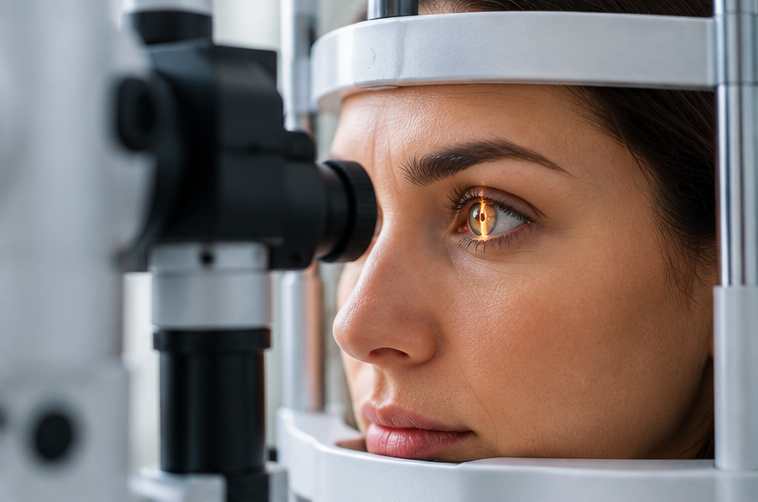
AMD can be detected during a comprehensive dilated eye examination.
Your doctor examines the retina and macula for changes that may indicate AMD.
Additional imaging, such as optical coherence tomography (OCT), may be recommended. OCT provides detailed images of the retina and can help doctors identify and monitor structural changes.
Why Have an Eye Exam If Your Vision Seems Fine?
Because early AMD may not affect your vision enough for you to notice.
That's one of the most important messages about macular degeneration.
Waiting until you can't see well isn't the best strategy for detecting an eye disease that may initially develop without symptoms.
Regular comprehensive eye examinations give your doctor an opportunity to identify changes earlier and determine whether additional monitoring or treatment is necessary.
Protecting Your Central Vision as You Age
Changes in vision aren't always an unavoidable part of getting older.
Age does increase the risk of several eye diseases, but identifying those conditions early can make an important difference in how they're managed.
At Blake Bush Family Eye Care in Ardmore, Oklahoma, we use comprehensive eye examinations and modern diagnostic technology to evaluate the retina, macula, optic nerve, and other structures that are essential to healthy vision.
If you're due for an eye examination or have noticed changes in your central vision, schedule an appointment with Blake Bush Family Eye Care.
Frequently Asked Questions
What is the first sign of macular degeneration?
Early AMD may have no noticeable symptoms. As it progresses, patients may experience blurry central vision, difficulty seeing in low light, or distortion.
Does macular degeneration cause blindness?
AMD primarily affects central vision rather than causing complete blindness. Advanced disease can nevertheless cause significant vision loss that makes reading, recognizing faces, driving, and other activities difficult.
At what age should I worry about macular degeneration?
Risk increases with age, particularly after age 55. Your individual risk also depends on factors such as family history and smoking.
What's the difference between wet and dry macular degeneration?
Dry AMD is more common and usually progresses more slowly. Wet AMD involves abnormal blood vessels beneath the retina and can cause more rapid vision loss
Can macular degeneration be detected before I notice symptoms?
Yes. Early AMD can be present without noticeable vision loss, which is one reason comprehensive dilated eye examinations are important
Are vitamins recommended for macular degeneration?
Certain nutritional supplements may be recommended for specific stages of AMD, but they aren't appropriate for everyone. Ask your eye doctor whether supplementation is appropriate for your individual situation.
About the Author
Blake Bush Family Eye Care is a leading provider of optometric services in Ardmore, Oklahoma. Our mission is to help every patient enjoy healthy, clear vision for life through advanced technology, personalized care, and genuine compassion. We provide comprehensive eye exams for all ages — starting at six months — and specialize in dry eye treatment, scleral lens fittings, and ocular disease management.
Serving Ardmore and surrounding communities, we’re committed to early detection, prevention, and customized solutions for every patient’s unique vision needs. Learn more at www.blakebushfamilyeyecare.com